BACK TO WORKSHEETS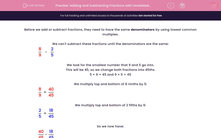


Before we add or subtract fractions, they need to have the same denominators by using lowest common multiples.
We can't subtract these fractions until the denominators are the same:
| 8 | - | 2 |
| 9 | 5 |
We look for the smallest number that 9 and 5 go into.
This will be 45, so we change both fractions into 45ths.
5 × 9 = 45 and 9 × 5 = 45
We multiply top and bottom of 8 ninths by 5:
| 8 | = | 40 |
| 9 | 45 |
We multiply top and bottom of 2 fifths by 9:
| 2 | = | 18 |
| 5 | 45 |
So we now have:
| 40 | - | 18 |
| 45 | 45 |
The answer is:
| 22 |
| 45 |
Example
Work out the following, remembering to give your answer in its lowest terms.
| 2 | + | 3 |
| 3 | 4 |
Answer
The lowest common multiple of 3 and 4 is 12, because 4 × 3 = 3 × 4 = 12.
We multiply top and bottom of 2 thirds by 4:
| 2 | = | 8 |
| 3 | 12 |
We multiply top and bottom of 3 quarters by 3:
| 3 | = | 9 |
| 4 | 12 |
So we now have:
| 8 | + | 9 |
| 12 | 12 |
This gives:
| 17 |
| 12 |
But this must be changed to a mixed number.
17 ÷ 12 = 1 remainder 5.
The answer is:
| 1 | 5 |
| 12 |