BACK TO WORKSHEETS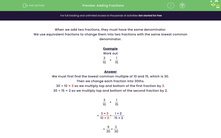


When we add two fractions, they must have the same denominator.
We use equivalent fractions to change them into two fractions with the same lowest common denominator.
Example
Work out
| 3 | + | 1 |
| 10 | 15 |
Answer
We must first find the lowest common multiple of 10 and 15, which is 30.
Then we change each fraction into 30ths.
30 ÷ 10 = 3 so we multiply top and bottom of the first fraction by 3.
30 ÷ 15 = 2 so we multiply top and bottom of the second fraction by 2.
| 3 | + | 1 |
| 10 | 15 |
| = | 3 × 3 | + | 1 × 2 |
| 10 × 3 | 15 × 2 |
| = | 9 | + | 2 |
| 30 | 30 |
| = | 11 |
| 30 |
We must always simplify or reduce our answer to its lowest possible terms.